
Cart (0)
No products in the cart.

For online sellers, manufacturers, retailers, and small businesses, courier shipping costs can quickly become a major expense. While courier rates themselves may be difficult to control, packaging is one area where businesses can make meaningful improvements.
A box that is unnecessarily large or heavy can increase shipping charges. On the other hand, packaging that is too small or weak may result in product damage, returns, replacements, and unhappy customers.
The goal is simple: use the smallest practical package that protects the product properly.
Courier companies commonly calculate shipping charges using the package's actual weight or volumetric weight, depending on the carrier's rules and service.
Volumetric weight takes the dimensions of the parcel into account. This means that even a lightweight product packed inside an oversized box may be charged at a higher weight.
For example, putting a small cosmetic product inside a large carton leaves unnecessary empty space and can increase the parcel's volumetric weight.
Before selecting packaging, check the weight and dimension rules of your courier partner.
One of the simplest ways to reduce shipping costs is to select a box that closely matches the size of your product.
Avoid using a 10-inch box when your product can safely fit inside a 6-inch box.
Properly sized packaging provides several benefits:
At MM WILL CARE, we offer corrugated boxes in many sizes so businesses can choose packaging according to their actual products instead of relying on one oversized carton for everything.
Accurate measurements are extremely important when choosing a shipping box.
Measure the product first and consider any additional space required for bubble wrap, paper cushioning, dividers, or other protective materials.
The package should have enough room to protect the product but should not contain excessive empty space.
For products with unusual shapes, test the final packed dimensions before ordering boxes in bulk.
Volumetric weight is particularly important for lightweight but bulky shipments.
Imagine shipping a small lightweight item inside a very large box. Although the actual product may weigh very little, the courier may calculate charges based on the amount of space the parcel occupies.
Using a more compact corrugated box can therefore help reduce the chargeable weight for some shipments.
This is especially useful for businesses shipping:
Always confirm the volumetric-weight formula with your courier company because formulas and billing policies can vary.
Using stronger packaging than necessary can add material, weight, and cost.
For many lightweight products, a properly specified 3-ply corrugated box may provide sufficient protection.
For heavier, fragile, or larger products, a 5-ply corrugated box may be more appropriate.
The correct choice depends on product weight, dimensions, fragility, stacking conditions, handling, and transportation distance.
The objective should not simply be to choose the thickest box available. Choose the right strength for the product and shipping conditions.
Bubble wrap, paper, foam, thermocol, and other protective materials are useful when required, but excessive cushioning increases package size and weight.
Use enough protective material to keep the product secure without unnecessarily filling the carton.
For example, instead of putting a small bottle in a very large carton and filling the remaining space with bubble wrap, consider using a smaller box designed around the bottle dimensions.
This can reduce both packaging consumption and parcel size.
Small products are frequently overpacked.
Items such as jewellery, cosmetics, soaps, candles, accessories, small bottles, electronic accessories, and gifts often do not require large shipping cartons.
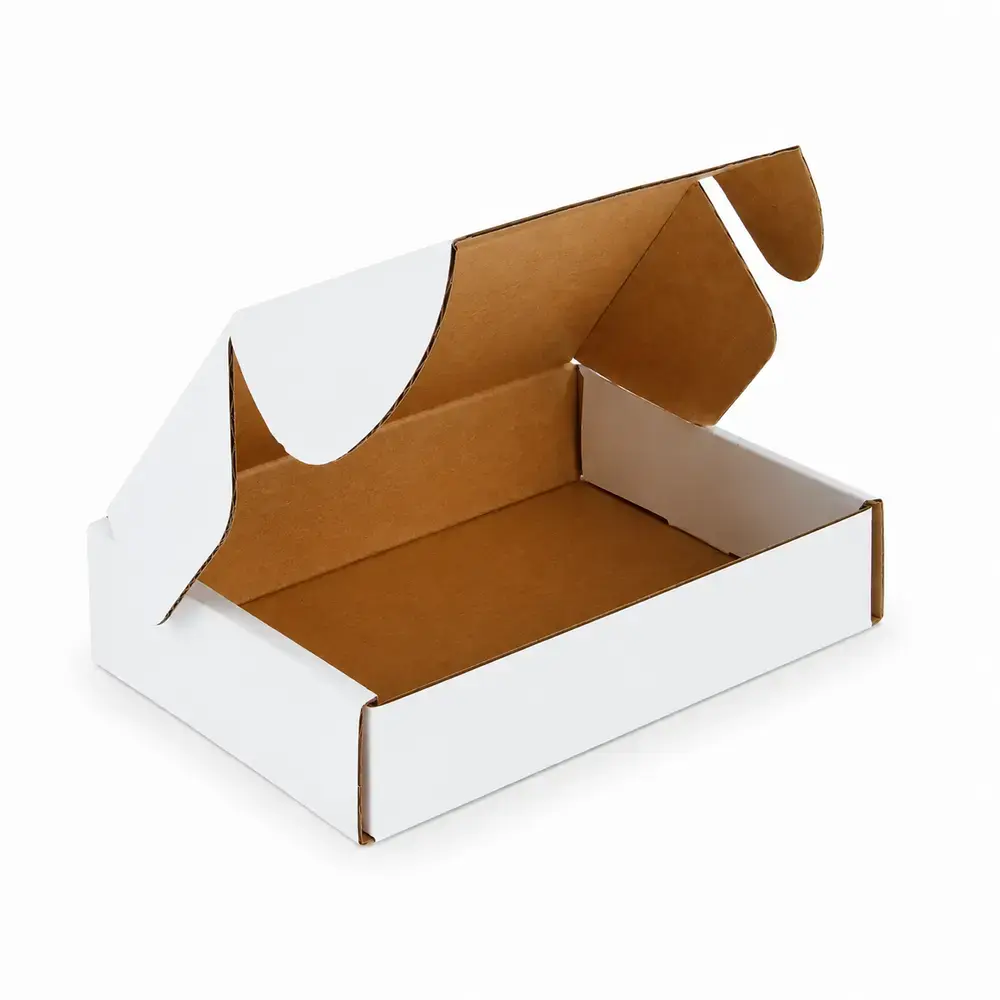
Compact corrugated boxes and self-locking mailer boxes can be useful for these products.
Smaller packaging can also make the parcel look more professional when it reaches the customer.
For suitable lightweight products, self-locking corrugated mailer boxes can provide a convenient packaging option.
They are commonly used for:
Their compact construction can help businesses maintain consistent package dimensions while providing an attractive unboxing experience.
Depending on the product and courier requirements, additional tape or protective material may still be necessary.
Businesses shipping 100 ml, 200 ml, and other small bottles should pay particular attention to box dimensions.
Using a box that matches the bottle arrangement can reduce unnecessary space.
For multiple bottles, consider using corrugated dividers or suitable cushioning to prevent movement and contact between bottles.
Glass bottles require additional protection compared with many plastic containers. Always perform packaging and transit tests before shipping fragile products at scale.
Businesses processing many daily orders can benefit from maintaining a selected range of standard box sizes.
For example, you could identify separate packaging sizes for:
Your packing team can then select the smallest suitable box for each order.
Standardization can improve packing speed, inventory management, storage efficiency, and shipping consistency.
Empty space inside a parcel provides little value but can increase its external dimensions.
Think of every unnecessary centimetre as space that must be stored, handled, transported, and potentially included in volumetric-weight calculations.
Before finalizing a box size, ask:
Can this product be packed safely in a smaller box?
If the answer is yes, changing the packaging may help reduce shipping costs across hundreds or thousands of orders.
Reducing packaging size should never mean using inadequate protection.
A damaged product can cost much more than the small saving achieved by using insufficient packaging.
Damage can lead to:
The best packaging strategy balances size, weight, strength, protection, and cost.
Before ordering thousands of boxes, conduct practical tests.
Pack the actual product using the proposed box and protective materials. Measure the final parcel dimensions and weight, and check the applicable courier charge.
For fragile products, conduct appropriate handling and drop tests.
Testing several packaging configurations can reveal which option provides sufficient protection with the lowest practical packed size.
Amazon, Flipkart, Meesho, Shopify, and independent website sellers often ship products with different sizes and weights.
Rather than using the same carton for every order, maintain several corrugated box sizes and select the closest suitable option.
A simple packing process can be:
Measure Product → Select Suitable Box → Add Necessary Protection → Measure Final Parcel → Check Chargeable Weight → Ship
This makes packaging decisions more systematic.
Choosing the correct packaging is not only about purchasing the cheapest box.
Consider:
Selecting the right combination can help reduce overall fulfilment costs rather than simply reducing the cost of the carton itself.
Choose the Right Packaging from MM WILL CARE
Reducing courier costs starts with selecting a box that closely matches the dimensions of the product. Instead of using one large carton for every shipment, consider different packaging sizes for different products.
For small products such as jewellery, cosmetics and electronic accessories, consider the 4 × 4 × 1.5 Inch Brown Self-Locking Corrugated Mailer Box. Its compact format can help reduce unnecessary empty space when it is appropriately sized for the item.
For other small e-commerce products, MM WILL CARE also offers 5.5 × 3 × 1.5 inch, 5.5 × 3 × 2.5 inch, 6 × 4 × 2 inch, 7 × 4 × 2 inch, and other self-locking mailer sizes.
For regular shipping requirements, you can browse the complete MM WILL CARE Corrugated Boxes & Packaging Products and select a box according to your product's actual dimensions, weight and protection requirements.
A useful CTA at the end of your article would be:
Need the right box for your shipment?
Explore MM WILL CARE's range of corrugated shipping boxes, self-locking mailer boxes and packaging materials. Choose a size that fits your product properly to minimize empty space and create a more efficient shipment.
Share:

Choosing a corrugated box affects how well your product travels, how much packaging you use, and your overall shipping c...

In the e-commerce and retail world, choosing the right packaging is just as critical as the product itself. If your box...

Jewellery and cosmetic products require packaging that is compact, attractive and strong enough to protect delicate item...
Wondering what products fit in a 6 × 4 × 2 inch box? This practical size is suitable for jewellery, cosmetics, mobile ac...